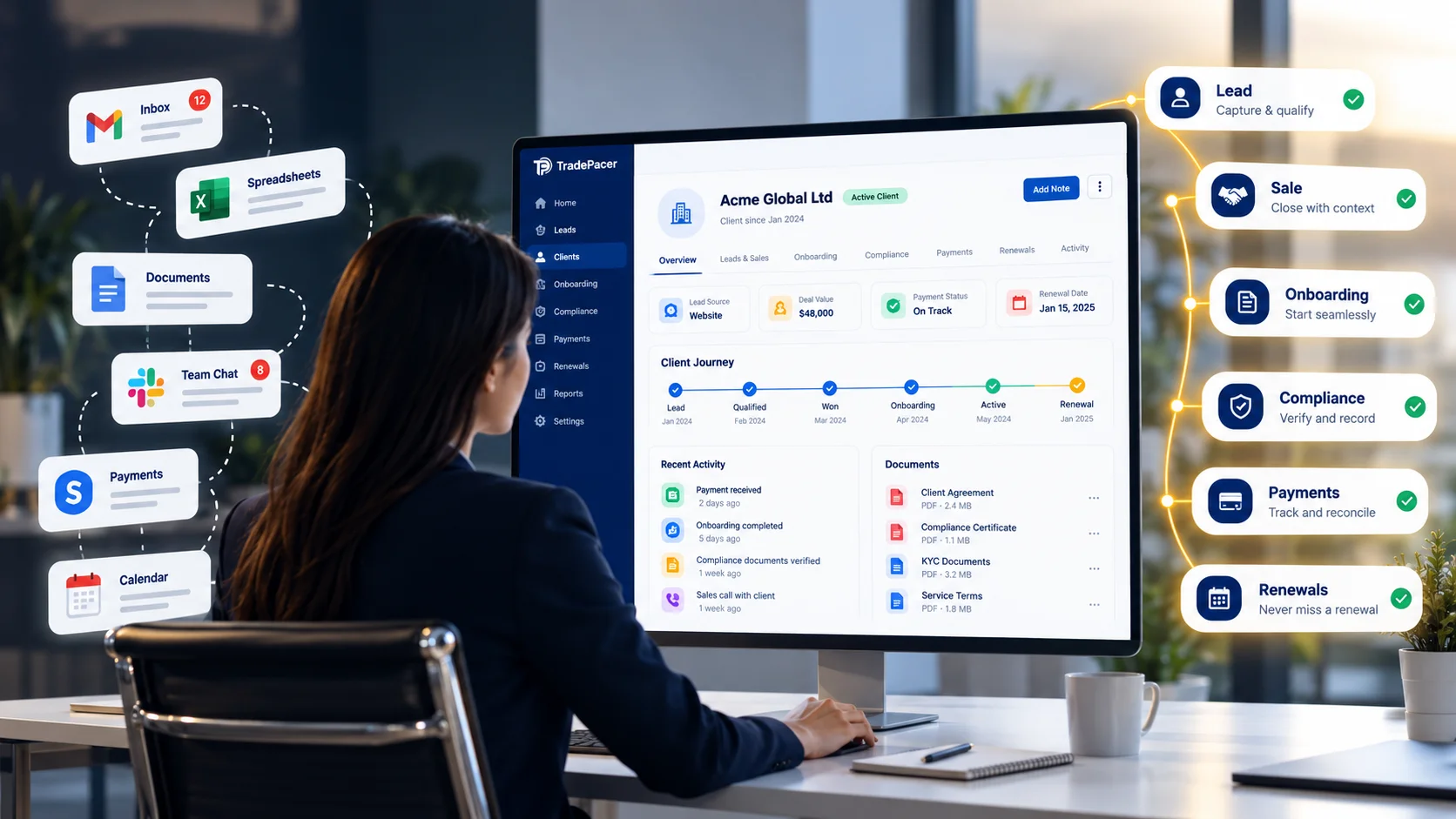
Most revenue teams do not struggle because they lack software. They struggle because the story of each client is scattered across too many systems.
A lead begins in one place. Qualification notes live somewhere else. Sales activity sits inside personal inboxes. Compliance documents are stored in another workflow. Payments are reconciled separately. Then, months later, somebody receives a calendar reminder saying that the client is due for renewal.
Each tool may work perfectly well on its own. The problem appears in the spaces between those tools — the handoffs where context, ownership, promises, and next actions are lost.
More software does not always create a better system
- Fragmented tools create fragmented ownership.
- Every manual handoff introduces delay and information loss.
- A connected lifecycle record gives every team the same client context.
- The goal is not fewer features. It is fewer disconnected workflows.
The fragmented client lifecycle
Consider a typical client journey.
Marketing generates an enquiry. Sales qualifies the opportunity. Someone follows up by phone or email. Documents are requested. A deal is agreed. Finance verifies a payment. Operations activates the service. Account managers handle ongoing requests, and eventually the relationship reaches a renewal point.
On an organisation chart, that process looks straightforward. Inside many businesses, however, each stage is handled by a different system.
- Leads enter through forms, spreadsheets or messaging channels.
- Sales activity is divided between a CRM and personal inboxes.
- Compliance documents sit inside shared folders or a specialist application.
- Payments are managed through a separate portal.
- Client service history is maintained manually.
- Renewals depend on spreadsheets, reminders or individual memory.
The company therefore has several sources of information, but no single source of client truth.
The expensive part of a fragmented stack is rarely the subscription cost. It is the operational friction created every time a client moves from one team to another.
The real cost of fragmented ownership
Fragmentation usually looks harmless at first. A team adds one specialist tool to solve one immediate problem. Then another. And another.
Eventually, the business starts spending significant time reconciling information rather than using it.
Follow-ups become inconsistent
When activity history lives in personal inboxes or notebooks, another team member cannot immediately see what happened, what was promised, or what should happen next.
The result is missed call-backs, duplicated messages, delayed decisions, and opportunities that quietly lose momentum.
Onboarding becomes a restart
A client should not feel that the relationship starts again after the sale.
Yet this happens when onboarding teams cannot see sales discussions, agreed requirements, relevant documents, commercial terms, or special commitments.
Management reporting becomes incomplete
A traditional sales dashboard may report pipeline value accurately while saying very little about what happens after conversion.
Managers then need spreadsheets and manual reports to understand onboarding status, payment exceptions, account activity and upcoming renewals.
Renewal risk appears too late
A renewal date by itself provides very little context. The real question is whether the organisation knows the complete history of the relationship before that date arrives.
What changes when the client record stays connected?
A connected CRM does not require every employee to work from exactly the same screen.
Different teams can still have different queues, dashboards, permissions and responsibilities. What matters is that they work around the same underlying client identity.
Lead history should continue into the opportunity. Opportunity context should continue into onboarding. Payment events should remain attached to the client. Service history should inform account management. Renewal teams should be able to understand the entire relationship without reconstructing it manually.
That continuity changes how teams work.
- Sales knows exactly where each opportunity stands.
- Operations receives context instead of just a name and email address.
- Finance can understand payment events in relation to the client record.
- Managers can see bottlenecks across the lifecycle, not only inside one department.
- Renewal conversations begin with history instead of guesswork.
Traditional CRM vs. lifecycle CRM
Traditional CRM software is often designed primarily around one moment in the relationship: winning the deal.
That is important, but for service-led businesses, the deal is only one stage of a much longer relationship.
Manage the opportunity
Capture leads, track activities, move deals through a sales pipeline and report on conversion.
Manage the relationship
Connect acquisition, conversion, onboarding, compliance, payments, service and renewal around one continuous client record.
The distinction matters because a company can have a highly organised sales pipeline and still deliver a fragmented client experience after conversion.
For businesses where long-term client value depends on onboarding, service, repeat transactions, account activity or renewals, the CRM needs to reflect more than the sales funnel.
Four principles for a connected client operation
Technology alone will not create continuity. The underlying operating model matters too.
One client identity
Teams should not create a new version of the client every time responsibility changes hands.
Clear ownership
Every meaningful activity should make it obvious who owns the next action and when it is due.
Context that moves with the client
Notes, documents, activities and commitments should remain accessible as the relationship progresses.
Reporting across the lifecycle
Management should be able to see where work is slowing down before that delay affects the client or revenue.
How do you know when your stack has become too fragmented?
You do not need to replace every specialist application simply because several systems are involved.
The warning sign is when people become the integration layer.
Consolidation is worth considering when your team regularly has to:
- copy the same client information between systems;
- ask colleagues for context that should already be recorded;
- maintain separate spreadsheets to understand operational status;
- manually reconcile sales, service and payment information;
- depend on individual employees to remember critical follow-ups;
- rebuild client history before important meetings or renewals.
These are not simply administrative inconveniences. They are indicators that the architecture of the workflow is working against the team.
The goal is continuity, not consolidation for its own sake
A connected system should not try to replace every specialist tool in the organisation.
The better question is whether each tool contributes to a coherent client journey.
TradePacer is built around that idea: capture the relationship at the beginning, maintain its context as it develops, and give every authorised team the information needed to move the client forward.
When ownership, history and next actions remain connected, employees spend less time searching for context and more time acting on it. Managers get a clearer picture of the operation. Clients experience fewer handoff mistakes.
And the CRM stops being a database that records what sales did. It becomes part of the operating system for the entire client lifecycle.
See TradePacer in action
One client record. One connected lifecycle.
See how TradePacer brings leads, client operations, payments and renewals together without forcing your team to reconstruct the client journey at every handoff.